


.png)
Market Commentary
-
The CPC Team
January 7, 2026
December 2025 Economic & Market Highlights
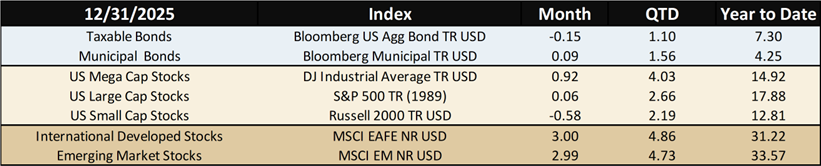
- U.S. stocks were relatively flat, with US Mega Cap Stocks up 0.9% and US Large Cap Stocks up 0.1%. US Small Cap Stocks on the other hand were down 0.6% as investors continued to favor larger, more liquid companies. Even with the Federal Reserve delivering a 0.25% rate cut in the month, ongoing uncertainty from prior data disruptions and a preference for perceived "quality" helped keep small caps on the back foot.
- Taxable Bonds fell 0.2% while Municipal Bonds rose 0.1%. The modest decline in Taxable Bonds reflected longer-term yields staying relatively elevated despite the Fed cut, as investors weighed large deficits and ongoing policy uncertainty.
- International Developed Stocks rose 3.0%, and Emerging Market Stocks rose 3.0%, supported by easing global financial conditions and currency tailwinds as tlhe U.S. dollar finished 2025 notably weaker. Overseas sentiment was also helped by steadier monetary policy abroad. Europe's central bank held rates in December and signaled a relatively resilient growth outlook.
The S&P 500 is an unmanaged index of 500 widely held stocks that is generally considered representative of the U.S. stock market. The Dow Jones Industrial Average (DJIA), commonly known as "The Dow" is an index representing 30 stock of companies maintained and reviewed by the editors of the Wall Street Journal. The Russell 2000 Index measures the performance of the 2,000 smallest companies in the Russell 3000 Index, which represent approximately 8% of the total market capitalization of the Russell 3000 Index. The MSCI EAFE (Europe, Australasia, and Far East) is a free float-adjusted market capitalization index that is designed to measure developed market equity performance, excluding the United States & Canada. The EAFE consists of the country indices of 22 developed nations. The MSCI Emerging Markets is designed to measure equity market performance in 25 emerging market indices. The index's three largest industries are materials, energy, and banks. Bloomberg US Aggregate (BBAG): The index is a measure of the investment-grade, fixed-rate, taxable bond market of roughly 6,000 SEC-registered securities with intermediate maturities averaging approximately 10 years. The index includes bonds from the Treasury, Government-Related, Corporate, MBS, ABS, and CMBS sectors. Bloomberg Municipal Bond Index: The index is a measure of the long-term tax-exempt bond market with securities of investment grade (rated at least Baa by Moody's Investors Service and BBB by Standard and Poor's). This index has four main sectors: state and local general obligation bonds, revenue bonds, insured bonds, and pre-refunded bonds.
Ready to begin?
Contact us


