



Bonds: It's Just Math
Investing can be complicated. Markets are influenced by economic growth, inflation, geopolitics, investor psychology and countless other variables that are difficult, if not impossible, to predict with precision.
Bonds, fortunately, give us a little more to work with. At their core, bonds are just math.
Consider a 10-year U.S. Treasury. If you purchase one yielding 15%, 5%, or 0.5% and hold it to maturity, your annualized return will ultimately land very close to the yield available when you bought it. The price may move considerably along the way as interest rates change, but the bond’s contractual interest and principal payments do not. In other words, the path can be messy, but the destination is set on day one.
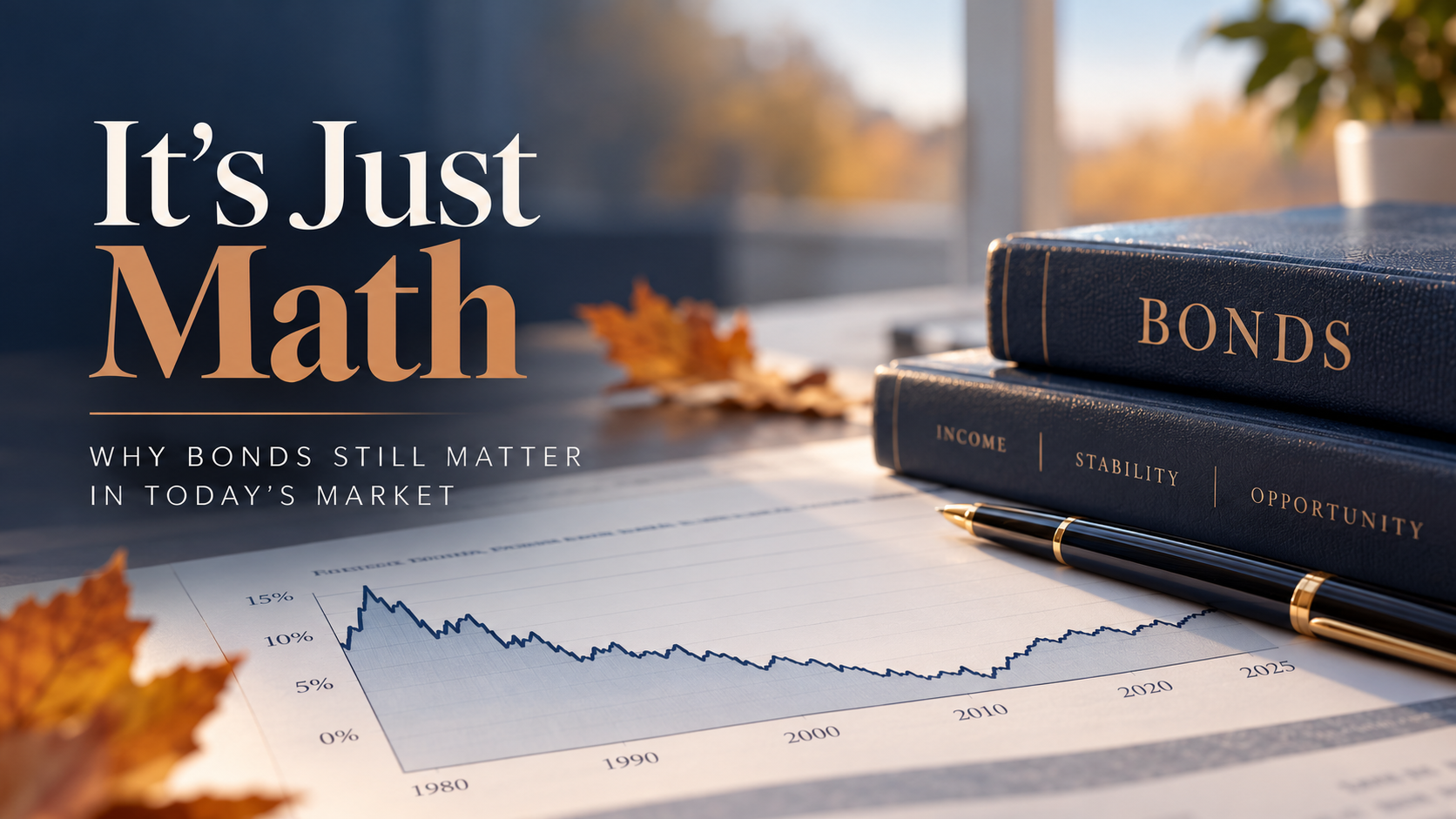
That math has produced very different experiences for bond investors across generations. In 1981, the yield on the 10-year U.S. Treasury briefly climbed above 15%. By August 2020, it had fallen to just over 0.5%. Investors buying Treasuries in the early 1980s locked in extraordinary yields. Investors buying near the historic lows of 2020 locked in something dramatically less attractive. Today, investors are starting from yields much closer to 5%.
That is why starting yield matters so much. For bonds, it is not simply a forecast. It is a large part of the return you are purchasing.
That math was put to a painful test in 2022
As inflation surged, the Federal Reserve embarked on one of the most aggressive rate-hiking cycles in decades. Bond prices fell sharply as yields moved higher, and the Bloomberg U.S. Aggregate Bond Index declined approximately 13%, its worst calendar-year return in history.
For many investors, it felt as though bonds had stopped working. In reality, the math was working exactly as it should.
Bond prices and yields move in opposite directions. When market rates rise, previously issued bonds paying lower rates become less attractive, causing their prices to fall. But that same adjustment creates higher yields for investors going forward. The painful repricing of 2022 was also the mechanism that rebuilt the return potential of fixed income.
That distinction was easy to miss. Headlines declared the “death of the 60/40 portfolio,” while more than a decade of low rates had conditioned investors to favor equities and other higher-returning assets. The irony was that investors were questioning the usefulness of bonds at almost precisely the moment their future return potential had improved.
Today’s starting point looks considerably different. At the time of this writing, the 10-year U.S. Treasury yields approximately 5.3%, with attractive yields available across much of the high-quality fixed-income market. That income gives investors something they had very little of in 2020 and 2021: a meaningful cushion against future changes in interest rates.
Let’s take the math one step further
Consider a diversified portfolio of high-quality bonds yielding approximately 5% with a duration of six years. Duration tells us that a 1% rise in interest rates should reduce the portfolio’s price by roughly 6%. Over a one-year period, however, approximately 5% of income would offset most of that decline, leaving an estimated total return near -1%. If rates instead fell by 1%, the math flips: roughly 6% of price appreciation plus 5% of income produces an estimated return near 11%. The price sensitivity is roughly symmetrical, but it is the 5% starting yield that tilts the potential outcomes in the investor’s favor, creating an asymmetrical risk-reward opportunity.
This does not mean bonds cannot lose money. Inflation can remain stubborn, interest rates can move higher, and credit conditions can deteriorate. But investors today are being paid considerably more to take those risks than they were only a few years ago.
Successful investing still requires patience, discipline and an understanding of what you own. With bonds, however, we are fortunate enough to know a meaningful part of the answer before we begin.
It’s just math.


